
The event supplier booking process, from first enquiry to paid invoice
By Nick Gage · 6 min read
The activity you run is probably not the thing that loses you corporate bookings. The gaps between stages are: the enquiry nobody replied to, the quote that was never followed up, the confirmed date that never made it onto the calendar, the invoice sent three weeks late to the wrong person.
This is the booking process we run at Battle Archery, stage by stage, with what to capture at each one. It is written for a supplier who turns up to the client's venue or a hired space - team-building providers, entertainers, photo booths, caterers - but most of it applies if you have a fixed location too.
Why does the process matter more than the activity?
A corporate client books you once on the strength of your activity. They rebook you, and refer you, on the strength of how easy you were to deal with. That means replying quickly, remembering what was agreed, turning up at the right address, and sending a clean invoice to the right person without being chased.
Every one of those is a process problem, not a talent problem. And every one of them gets harder as you grow, because the enquiries stop arriving one at a time. The point of a defined process is that the fifth enquiry of the week gets the same treatment as the first.
Stage 1: the enquiry arrives. What do you capture?
Corporate enquiries come in by email or through a form on your website, and occasionally by phone. Whatever the channel, the first job is to get it out of your inbox and into a list of open enquiries before you do anything else. An enquiry that only exists as an unread email is an enquiry that will be buried by lunchtime.
Capture the sender, their company, the preferred date, the rough headcount, the location if given, and the occasion. If any of those are missing, that becomes the first question in your reply. Record where the enquiry came from as well. Knowing that your corporate work comes from Google rather than Instagram changes where you spend your marketing time.
Stage 2: qualify and quote
Reply the same business day with a per-person price, your minimum, what is included, and the questions you need answered to confirm. Our full reply template is in the companion guide on responding to corporate enquiries. The aim of this stage is one email that the enquirer can forward to their manager without editing.
Then set a follow-up. Corporate enquirers go quiet not because they chose someone else, but because the approval got stuck. A short nudge three business days later ("just checking whether the 24th still works, happy to hold it another week") recovers a surprising share of them. If you do not track which quotes are waiting on a reply, you will not send that nudge.
Stage 3: hold the date, then confirm
Treat "yes, pencil us in" and "yes, booked" as two different stages, because they are. A held date has an expiry. A confirmed booking has a written confirmation, a headcount deadline and an invoice on the way.
When a client asks you to hold a date, say for how long, and put the hold on your calendar so you do not double-book it. When they confirm, send a confirmation email the same day that restates the date, start and finish time, venue address, headcount and price, and tells them when the final numbers are due. That email is the contract for most small providers. Make it complete.
Stage 4: the run sheet. Venue, travel, headcount, kit
This is the stage most guides skip and most events go wrong at. A confirmed booking needs to become a plan for the day, and that plan needs to be visible to whoever is running the event, not just to you.
- Venue address and access notes: loading dock, parking, which entrance, who to ask for on arrival.
- Travel and setup time, worked backwards from the start time. For a mobile activity, arrival time is a separate calendar entry from start time.
- Headcount, and the date the final number is due.
- Client contact for the day, with a mobile number. This is often not the person who booked.
- Equipment list, and who is bringing it.
- Staff assigned, and whether they have seen the run sheet.
Put all of it on the booking record and on the calendar entry itself, so a staff member opening the calendar on their phone at 7am sees the address and the contact, not a title that says "Corporate group, 20 people".
Stage 5: reminders and final headcount
Send a reminder a week out. It confirms the date is still on, asks for the final headcount, and repeats the venue and time. If you charge per head with a minimum, this is where the invoice amount gets settled. A second, shorter reminder the day before is worth it for corporate clients, because the person who booked may be relying on the reminder to remind their own team.
Automate this if you can. It is the same email every time, and the version you send by hand is the one that gets forgotten in a busy week.
Stage 6: invoice and follow up
Invoice on the day of the event or the next morning. Corporate accounts payable runs on a cycle, and an invoice that arrives three weeks late misses a cycle and gets paid two months later. Address the invoice to the person the client named at confirmation, put their purchase order number on it if they gave you one, and reference the event date so finance can match it.
A week after the event, send a two-line follow-up: thanks, a question about how it went, and an offer to hold a date for next quarter or their end-of-year event. Most of our repeat corporate bookings come from that email, not from the client remembering us unprompted.
What should you track? The simplest pipeline that works
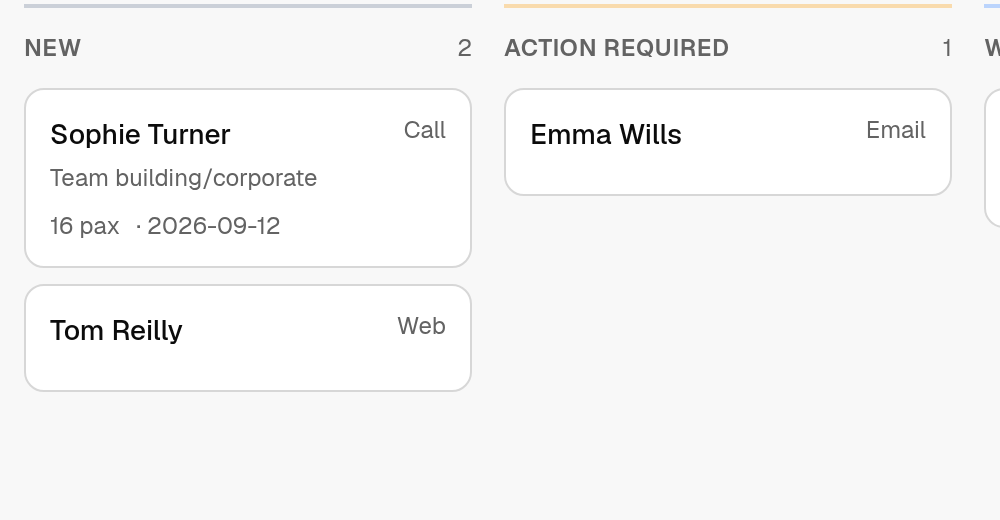
You do not need a sales methodology. You need to know, for every open enquiry, whose move it is. Four columns cover it.
- New: it has arrived and nobody has replied yet. Anything here for more than a few hours is a problem.
- Action required: your move. A quote to send, a question to answer, a follow-up that is due.
- With client: their move. You have sent the quote or the confirmation and are waiting. Set a date to nudge.
- Booked: confirmed, on the calendar, run sheet done, invoice scheduled.
Move each enquiry across as it progresses and glance at the board once in the morning and once in the afternoon. The board tells you what to do next without you having to reread every thread.
That is the whole process. Leadesi is built around exactly these stages: an email or form enquiry becomes a lead with the date, headcount and venue already pulled out, the lead moves across a board like the one above, and when it is booked it goes onto the staff calendar with the run-sheet details, sends the confirmation and reminders, and drafts the invoice for Xero. The client record then holds everything for the rebook. But the process comes first. Get the stages right and the tools are easy to pick.
Common questions
- How far in advance do corporate clients book team-building events?
- Typically two to six weeks out, with end-of-financial-year and December events booked earlier. Enquiries arriving within a fortnight of the date are common and usually mean another provider fell through, so a fast reply wins them.
- When should I invoice a corporate team-building booking?
- On the day of the event or the next morning, addressed to the finance contact the client named at confirmation, with any purchase order number and the event date on it. Late invoices miss accounts-payable cycles and get paid months later.
- What should a team-building booking confirmation email include?
- The date, start and finish time, venue address, agreed headcount and minimum, per-person price including GST, the date final numbers are due, and the client contact for the day. For most small providers this email is the contract.
- Do I need a CRM to manage team-building bookings?
- Not at first. A shared calendar and a list of open enquiries with a status column will work until you have several enquiries open at once. The point at which people move to a tool is usually when a quote goes unanswered or a booking misses the calendar because it only lived in email.
About the author
Nick Gage. Founder, Leadesi. Runs Battle Archery, a mobile team-building business in Sydney. Read the Leadesi story.
Run this process without the spreadsheet
Leadesi tracks every corporate enquiry through these exact stages, from the first email to the Xero invoice. Free to start.