
How to reply to a quote request email (with a template for event and activity providers)
By Nick Gage · 8 min read
Most quote requests arrive as two lines: "can you do this, and how much?" The person asking is usually shopping several providers at once, often is not the person paying, and frequently has someone waiting on their answer. Whoever gives them a clear, confident reply first tends to win.
This guide is what we do at Battle Archery, where most corporate bookings start exactly that way. The example is a team-building enquiry, but the shape of the reply is the same for a party, a wedding booth or a mobile detail. It covers what the request is really asking, what you need before you can quote, how fast to reply, and the exact reply we send.
What does a quote request actually look like?
Most arrive as a short email or a web-form submission from an office manager, an executive assistant, a people-and-culture lead, or a team lead who drew the short straw. It reads something like: "Hi, we are looking at a team activity for about 20 people in late October, ideally near the office in Surry Hills. Can you send some info and pricing?"
Read it again and notice what is missing. No exact date, no budget, no venue confirmed, "about 20" people, and "some info" rather than a specific package. That vagueness is normal. The sender often does not have those answers yet, and part of your job in the first reply is to make it easy for them to get them.
The other thing to notice is the tone. It is polite, brief and slightly transactional. They are not asking you to sell them on team building. They have already decided to do something. They are asking whether you can do it on their terms, and whether you are easy to deal with.
What do you need to know before you can quote?
You can give a price range from almost nothing, and you should. But a firm quote for a mobile activity depends on five things, and asking for all five at once in a friendly way is the fastest path to a booking.
- Date and time window. Corporate groups usually want a weekday afternoon, and Fridays book out first. Ask for a preferred date and a backup.
- Headcount, with a realistic range. Twenty confirmed is different from "somewhere between 12 and 30". Price per head with a minimum, and say what the minimum is.
- Location. For a mobile activity this is the venue's address, not the company's. Ask whether they have a space (their office, a park, a function room) or need you to suggest one. Travel and setup time come straight from this.
- Occasion. End of quarter, onboarding a new team, a client day, a farewell. It changes what you recommend and how formal the invoice needs to be.
- Who approves. If the enquirer needs sign-off from someone else, you want to know now, so your quote can be forwarded without a second round of questions.
If your web form asks for these up front you will get them on maybe half of enquiries. The other half come through as plain email and you have to ask. Either way, ask once, in one message, not across four replies.
How fast do you need to reply?
Same business day, and ideally within the hour if it comes in during work hours. That is not a hustle-culture rule, it is how corporate procurement works at this scale. The enquirer has probably emailed two or three providers from a list and will go with whoever makes the next step easy. A reply the following morning often lands after a decision has already been made.
The practical problem is that you are running events, not sitting at a desk. The fix is not to reply faster from the van. It is to make sure every enquiry is visible somewhere you will see it within the hour, that nothing gets buried under a thread from a different client, and that the first reply is mostly written already.
If you genuinely cannot reply properly for a few hours, send a two-line holding reply from your phone: thanks, yes we can likely do that date, full details and pricing by 4pm. That short message does most of the work of the full reply, because it answers the real question, which is "will this person be easy to deal with".
How do you reply to a quote request? The template
The first reply has three jobs: confirm you can do it, give them a number they can take to their manager, and ask for the missing details in a way that is quick to answer. It should not be a brochure. Planners forward these emails internally, so write it so it still makes sense when read by someone who has never heard of you.
Here is the shape of the reply we send. Swap in your activity, your price and your minimum.
Reply template
Subject: Re: Team activity for ~20 in late October

Hi Priya,

Thanks for getting in touch. Yes, we can do late October and we regularly run sessions for groups of 20 in the Eastern Suburbs.

Quick summary so you can pass it on:
- Activity: 2-hour combat archery session, fully run by our team
- Price: $60 per person, minimum 12 people (so $1,200 for 20)
- We bring everything and set up at your venue, or we can suggest a park or indoor space nearby
- Includes GST.

To lock in a date I just need:
1. Your preferred date and a backup
2. A rough headcount (a range is fine)
3. Where you would like to run it, or whether you want a suggestion

Reply here or call me on 0400 000 000 if that's easier.

Nick
Battle Archery
Notice the reply does not ask about budget. Corporate enquirers rarely answer that question honestly and it makes the email feel like a negotiation. Give them your price and let them react to it. Notice also that it names a specific next action: pick a date. A reply that ends with "let me know if you have any questions" ends with nothing.
How do you handle multiple stakeholders?
A typical corporate booking involves three people: the one who emailed you, the manager who approves the spend, and the finance person who pays the invoice. Sometimes there is a fourth, the venue contact. Each of them will appear at a different stage and none of them will have read the earlier emails.
Keep everything in one email thread and reply-all when a new person is added. Do not start a fresh thread for the quote, the confirmation and the invoice, because the finance person will then ask you what this invoice is for. When the approver joins, restate the essentials in one line at the top of your reply: date, headcount, venue, price. That one line is what they will actually read.
Keep the details somewhere other than the thread as well. Once the date, venue, headcount and contact names live in a single client record, you can answer "what did we agree with them" in ten seconds instead of scrolling a 30-message thread on the day.
What happens after they say yes?
A "yes" from a corporate client is usually "yes, pencil us in" rather than "yes, invoice us". Confirm in writing what "yes" means: the date is held, the price is per person with a minimum, and the final headcount is due a set number of days before. Send a short confirmation email the same day that lists the date, start time, venue address, headcount and price, and tell them what you need from them next and when.
Then put it on your calendar, and on the calendar of whoever is running it, with the venue address and the client contact on the entry. Most no-shows and wrong-venue disasters in this business are not the client forgetting. They are the operator having the right details in an email and the wrong details on the calendar.
Send a reminder a week out asking for the final headcount, invoice as soon as the event is done while the goodwill is fresh, and add a line in your follow-up asking whether they would like to hold a date for next quarter. Corporate clients rebook. The enquiry you answered well in October is the one that comes back in March.
Where does Leadesi fit in?
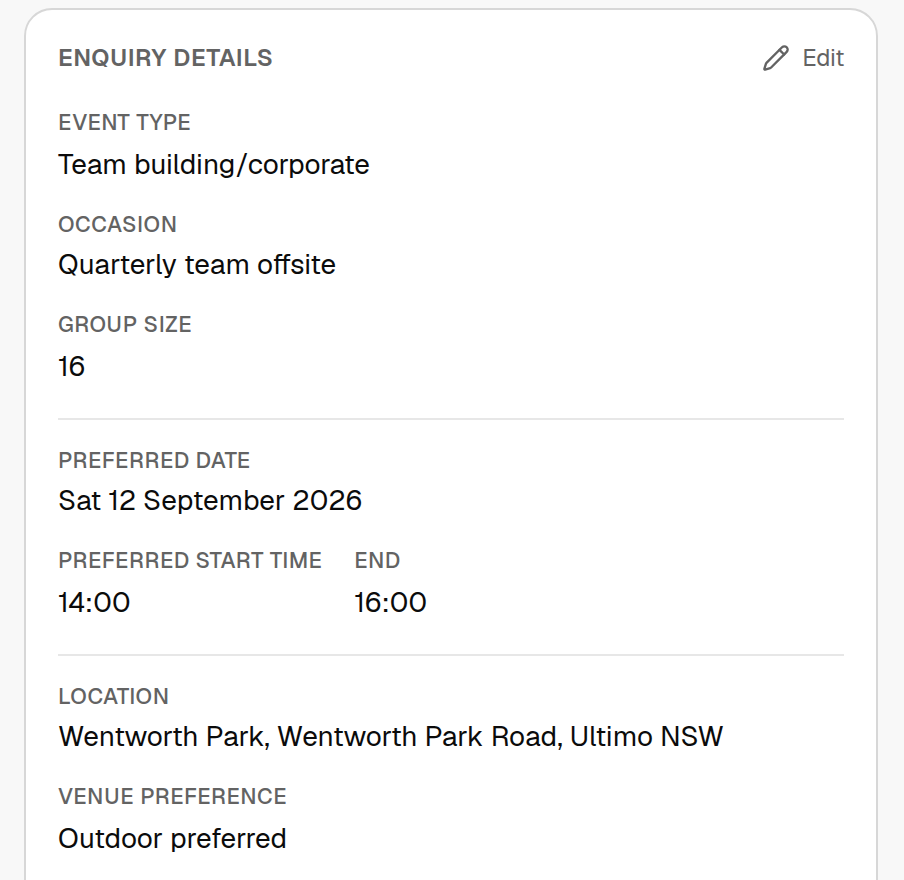
Everything above works with Gmail, Outlook, and a spreadsheet. Leadesi exists because the spreadsheet stops working around the fifth simultaneous enquiry. When a corporate enquiry arrives by email or through your web form, Leadesi creates a lead and pulls the date, headcount, location and occasion out of the message so you can see what is being asked without opening it. You reply from Gmail or Outlook like you always have, the thread stays linked to the lead, and the lead sits on a pipeline that shows who is waiting on you.
When they say yes, one click turns the lead into a booking on the staff calendar with the venue and headcount attached, sends the confirmation, and drafts the invoice for Xero. The client record keeps the whole history for when they come back next quarter.
Common questions
- Should I include pricing when I reply to a quote request?
- Yes. Give a per-person price and your minimum group size so the enquirer can take a number to their manager. Planners are comparing several providers, and a reply that withholds pricing until a call usually gets skipped.
- How quickly should I reply to a quote request?
- Same business day, ideally within an hour during work hours. If you cannot send the full reply, send a two-line holding reply confirming you can likely do the date and when the details will follow.
- Do I need a deposit to hold a corporate booking date?
- Most small providers hold a date for a set period, commonly 7 days, without a deposit, then confirm with a written booking and invoice. Corporate finance teams are often slow to pay deposits, so a short free hold plus a firm final-headcount deadline usually works better than a deposit.
- What details do I need before I can confirm a corporate team-building booking?
- A confirmed date and start time, a headcount or a range with a minimum, the venue address (or an agreement that you will suggest one), the client contact for the day, and who the invoice should go to.
About the author
Nick Gage. Founder, Leadesi. Runs Battle Archery, a mobile team-building business in Sydney. Read the Leadesi story.
Answer every quote request in the hour, not the next day
Leadesi captures each enquiry, pulls out the date, headcount and venue, and tracks it to a booked event. Free to start.