
The 5-minute rule for leads, and what it means when you're on a job
By Nick Gage · 8 min read
The 5-minute rule is the most quoted piece of advice in lead management: reply to a new enquiry within five minutes or watch your odds collapse. It comes from real research, and the research is more striking than most of the blog posts that cite it. It was also done on sales teams sitting at desks with a phone, which is not you when a lead lands while you are mid-job.
This guide covers what the rule says, where the numbers come from, which parts survive contact with a small service business, and the practical version we run at Battle Archery when most enquiries arrive while the team is out on an event.
What is the 5-minute rule for leads?
The 5-minute rule says that when someone enquires through your website or by email, you should make first contact within five minutes. Not send a quote, not solve their problem. Just respond, as a human, fast enough that you are the first business they hear back from.
The rule exists because the odds of reaching and converting a lead fall off a cliff in the first half hour, not over days. Most businesses behave as if a lead is still warm the next morning. The research says it could already be gone.
Where does the 5-minute rule come from?
Two studies, both led by Dr James Oldroyd, then at MIT, and both usually mislabelled as "the Harvard study".
The first is the Lead Response Management Study, done with InsideSales.com. It analysed three years of data across six companies, more than 15,000 leads and over 100,000 call attempts, and measured what happened when a lead was called back at different delays. The headline finding: the odds of making contact with a lead called within five minutes were about 100 times higher than for a lead called at 30 minutes, and the odds of qualifying that lead were about 21 times higher. Five minutes was not a magic number. It was the point past which the curve dropped fastest.
The second is the Harvard Business Review piece, "The Short Life of Online Sales Leads" (March 2011). The researchers submitted a test enquiry to 2,241 US companies and timed the reply. Thirty-seven per cent answered within an hour. Sixteen per cent took between one and 24 hours. Twenty-four per cent took longer than a day. Twenty-three per cent never replied at all. Among companies that did reply within a month, the average response time was 42 hours.
Read those two together and the lesson is not really "reply in five minutes". It is that almost nobody does, so replying inside the hour puts you ahead of most of the businesses your enquirer has also emailed.
Does the 5-minute rule apply to a one-person service business?
Partly. The studies were about phone calls made by sales teams to people who had filled in a form on a company website, mostly in the US, mostly business-to-business. Your enquiries are a parent asking about a Saturday party, or an office manager asking about a team activity in October. The numbers do not transfer exactly.
The mechanism does transfer. Your enquirer has almost certainly sent the same message to two or three other providers. They are still at their desk, still thinking about it, and still checking their inbox for the next few minutes. Whoever replies first gets to shape the conversation, and often gets the booking before the others have opened the email. An hour later they have moved on to something else. The next morning they may have already booked.
What does not transfer is the assumption that you are free to reply. A sales rep at a desk can hit five minutes. A magician mid-show, a detailer under a bonnet or an events team running a session cannot, and should not try. The practical question is not "how do I reply in five minutes" but "how do I make sure every enquiry is answered inside the hour without being glued to my phone".
What counts as a response?
A human reply. The research measured contact, not acknowledgement. An automatic "thanks for your enquiry, we will be in touch" does not count, because the enquirer knows it is automatic and it tells them nothing they wanted to know.
The reply does not have to be complete, though. A two-line message from your phone that answers the one question the enquirer actually has, which is usually "can you do it", buys you hours. It confirms availability, sets a time for the full reply, and signals that you are easy to deal with. That signal is most of what the first reply is for.
Holding reply (send from your phone)
Hi Priya,

Thanks for getting in touch. Yes, we can most likely do a session for 20 in late October - I'm running an event right now but will send full details and pricing by 4pm today.

Nick
That message takes fifteen seconds to send and does more for the booking than a perfect quote sent tomorrow morning. Then the full reply goes out at the time you promised, which is the second thing the enquirer is now judging you on.
How do you hit the rule when you're the one doing the work?
You cannot watch your inbox all day and you should not have to. The businesses that reply fast are not more disciplined than you. They have removed the reasons an enquiry goes unseen.
- One place every enquiry lands. If some come through a web form, some by email and some by a contact page that forwards to a different address, the one you miss will be the one you did not check. Every enquiry should create a lead in a single list, whatever channel it arrived on.
- A notification you will actually see. A push notification on your phone for a new lead, not just an unread-email badge in an inbox that also holds receipts and newsletters. Make the new-lead signal distinct from everything else.
- A holding reply you can send from your phone in seconds. The template above, saved somewhere you can paste it from. The full quote can wait for a fixed time; the acknowledgement cannot.
- A form that asks the right questions. If your web form collects the date, headcount and location, your first reply can answer with a price instead of a question. That turns the holding reply into a near-complete reply.
- Two fixed times a day for full replies. Say 8am and 4pm. Every enquiry gets its holding reply within the hour and its full quote at the next slot. Batching the long replies is faster than writing them piecemeal, and it makes the promise in the holding reply easy to keep.
- A pipeline column with new leads that you empty. If you can see at a glance which enquiries nobody has replied to, the ones that arrived during a job are impossible to forget, then you are well on your way.
What if you can't reply within five minutes?
Then reply within the hour, and if you cannot do that, reply the same day. The curve is steepest early, but it keeps sloping. Every hour you wait, more of the other providers have replied and more of your enquirers have made up their minds.
The Harvard audit found that only about a third of businesses reply inside the hour and nearly a quarter never reply at all. That is your competition. You do not need a call centre to be faster than most of it. You need to never let an enquiry sit unseen, and to send a two-line human reply before you send a full one.
How do you measure your own response time?
For two weeks, note when each enquiry arrived and when you first replied. The timestamp on the enquiry email or form submission and the timestamp on your reply are all you need. Work out the median, not the average, because one enquiry you missed over a long weekend will swamp the average and hide the real pattern.
Then look at the misses. Almost always they cluster: enquiries that came through a channel you check less often, or that arrived during a particular kind of job, or on a particular day. That cluster is the thing to fix. Response time is rarely a discipline problem. It is a visibility problem with a discipline problem painted on top.
Where does Leadesi fit in?
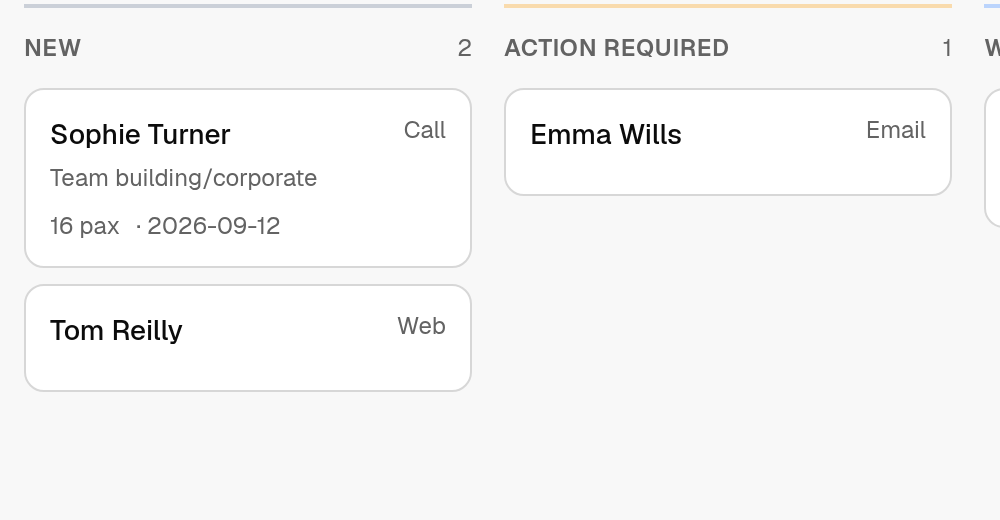
Leadesi is built around the visibility half of this. Every email enquiry is just one click away from a fully populated lead moments after it lands, with the date, location, group size and other details already pulled out of the message. New leads sit in a "new" column on a board until someone replies, so an enquiry that arrived during a job is impossible to lose. You reply from Gmail or Outlook like you always have, and the thread stays linked to the lead.
It does not reply for you, and it should not. The two-line holding reply from your phone is the part that wins the booking, and it takes fifteen seconds once you can see that the lead is there.
Common questions
- What is the 5-minute rule for leads?
- Make human first contact with a new enquiry within five minutes of it arriving. It comes from the MIT and InsideSales.com Lead Response Management Study, which found the odds of reaching a lead called within five minutes were about 100 times higher than at 30 minutes, and the odds of qualifying it about 21 times higher.
- Is the 5-minute rule from Harvard?
- Not quite. The five-minute figures come from the MIT and InsideSales.com study. Harvard Business Review published a related audit in 2011, "The Short Life of Online Sales Leads", which timed replies from 2,241 US companies: 37% answered within an hour and 23% never replied.
- Does an automatic reply count as responding to a lead?
- No. The research measured human contact. An auto-reply tells the enquirer nothing they wanted to know and they can tell it is automated. A short, human holding reply from your phone that confirms availability and promises a full reply by a set time does count.
- What is a good lead response time for a small service business?
- Inside the hour for a human reply, and the same business day for a full quote. Only about a third of businesses reply within an hour and nearly a quarter never reply, so an hour already puts you ahead of most of the providers your enquirer has also contacted.
About the author
Nick Gage. Founder, Leadesi. Runs Battle Archery, a mobile team-building business in Sydney. Read the Leadesi story.
See every new enquiry the moment it lands
Leadesi turns each email or web-form enquiry into a lead with the details already pulled out, in a board that shows who is still waiting on you. Free to start.