
How to start a coffee cart business in Australia
By Nick Gage · 9 min read
A coffee cart is one of the cheapest ways into hospitality in Australia: no lease, no fit-out of a shop, and a business you can take to wherever the customers are. It is still a food business, though, and the paperwork, the gear and the way you price your work all depend on which kind of coffee cart business you are actually starting.
This guide covers both kinds, trading to the public at markets and on the street, and hiring the cart out for weddings, offices and events. It goes through what you need to register, the permits in NSW, Victoria, Queensland and Tasmania, what a fitted cart costs, how event hire is priced, and how to handle the booking enquiries once they start arriving.
Is a coffee cart business a good idea?
It can be, if you are clear about which business you are running. There are two, and they work very differently.
The first is trading to the public: a regular spot at a market, a sports ground or a roadside site, selling coffee by the cup. Your income depends on foot traffic and weather, and your permits are about where you are allowed to set up.
The second is event hire: a wedding, an office morning tea or a corporate conference books the cart and a barista for a set number of hours, usually at a package price agreed in advance. People clearly look for this. Searches like "coffee cart hire prices" come up for Sydney, Melbourne and Adelaide specifically. A booked event pays the same whether it rains or not, which is why many operators build towards hire work even if they start at markets.
Most carts do some of both. Decide which one you are building around, because it changes the gear, the permits and how you find work.
What do you need to start a coffee cart business?
Before you trade, you need the business set up, the food side approved, the right to trade where you plan to, and insurance. In order:
- An ABN, the first thing everything else asks for.
- A registered business name with ASIC, if you will trade under any name other than your own.
- GST registration when your GST turnover will reach $75,000 a year. Many new carts start below that and register later.
- Food business registration or a licence, through your council or state food authority. This is the step that varies most by state (next section).
- A Food Safety Supervisor and trained food handlers, if your food handling falls under the national food safety rules described below.
- Permission to trade at each place you operate: a council permit for public land, a market or event organiser's approval, or written permission from a private landowner.
- Public liability insurance. Event organisers and councils will ask for a certificate of currency before they let you trade.
- The cart, an espresso machine, a grinder, milk refrigeration, a power source and a water supply.
The GST rule is set by the ATO and summarised on business.gov.au: you must register within 21 days of becoming aware your GST turnover will reach $75,000.
The food safety rules come from Standard 3.2.2A of the Food Standards Code, which has applied since December 2023. Businesses in category two, a retailer of ready-to-eat, potentially hazardous food handled unpackaged, need a certified Food Safety Supervisor (certificate obtained in the past five years) and trained food handlers. Category one businesses also have to keep records proving their critical food safety controls. Ask your council which category your menu puts you in before you buy anything, because the answer decides what training you need.
Do you need a licence or permit for a coffee cart?
Yes, and usually two kinds: approval to sell food at all, and permission to trade in a particular place. How the first one works depends on your state.
NSW. Mobile food vendors register with their local council and must follow the NSW Food Authority's Guidelines for Mobile Food Vending Vehicles. Councils inspect the vehicle before approving it. Penrith City Council, for example, requires annual inspections for roadside vendors and an inspection report from your home council if your vehicle is based elsewhere.
Victoria. Mobile and temporary food businesses register once through the state's FoodTrader system (formerly Streatrader), which assigns your class and your principal council. Before each trading day or event you lodge a free statement of trade, at least one day before, as Boroondara Council explains.
Queensland. A business that sells only drinks, such as tea and coffee, does not need a food business licence, though it must still follow food safety laws. Add food to the menu and you may need one: the licence covers businesses that make food or sell unpackaged food by retail, and one licence covers a mobile business anywhere in the state. It lasts up to three years, and a licensed business must appoint a Food Safety Supervisor who is available whenever it is operating.
Tasmania. You need a council mobile business permit (up to 12 months) to trade on a public street, plus statewide registration as a mobile food business if you serve food for immediate consumption on a street, reserve or car park.
Elsewhere. Start with your council's environmental health team, and use the Australian Business Licence and Information Service to list everything that applies to your postcode and activity.
The place permits are separate from all of this. A council permit to trade on public land, a stallholder agreement with a market, or an event organiser's vendor approval each come with their own conditions about hours, noise, waste and power.
How much does it cost to start a coffee cart business?
The cart and coffee gear are the biggest single cost. As one published example, a Sydney supplier lists a new turnkey cart package for $13,200: a 1.2 metre stainless steel cart, a one-group commercial espresso machine with a built-in water tank, an automatic doser grinder, fresh and waste water canisters, and barista accessories, running off a standard 10 amp outlet. Second-hand carts and bare carts that you fit out yourself cost less. A van with a generator costs considerably more.
After the gear, budget for:
- Milk refrigeration, if it is not built into the cart.
- Power for sites without a 10 amp outlet: a generator or a battery system.
- Registration, licence and permit fees, set by each council or state and reviewed every year.
- Food Safety Supervisor certification and food handler training.
- Public liability insurance.
- Opening stock: beans, milk, cups, lids and cleaning supplies.
- A way to move the cart: a trailer, a van or a hired vehicle, and somewhere secure to store it.
- A card reader, a simple website and a booking enquiry form.
How much does a coffee cart make?
There is no reliable public data on what Australian coffee carts earn. What you can work out is what one booking is worth, because event hire is priced in packages you can see.
Published price points give you a sense of the range. One Sydney wedding coffee cart lists packages from $600 for two hours of barista service, including 100 coffees. Hiring an event barista alone costs around $65 an hour with a four-hour minimum from one Sydney supplier, which tells you roughly what the labour in a package is worth if you hire staff.
Take a package price, subtract the barista's time (including setup, travel and pack-down, not just service hours), the beans, milk and cups for the number of coffees included, and the cost of getting there. What is left is your margin on that booking. Do that sum for a wedding, an office morning and a conference, and you will know which bookings to chase. Whether the business is profitable then comes down to how many of those days you can fill, which is a question of how many enquiries you get and how many you turn into bookings.
How do you price coffee cart hire for events?
Most event coffee is sold as a package: a set number of hours of service, with either a number of included coffees or unlimited coffee for the guest count. On top of that come extra hours, travel outside your area, and extras like alternative milks or a branded cup. A clear minimum booking protects you from driving an hour for a 45-minute job.
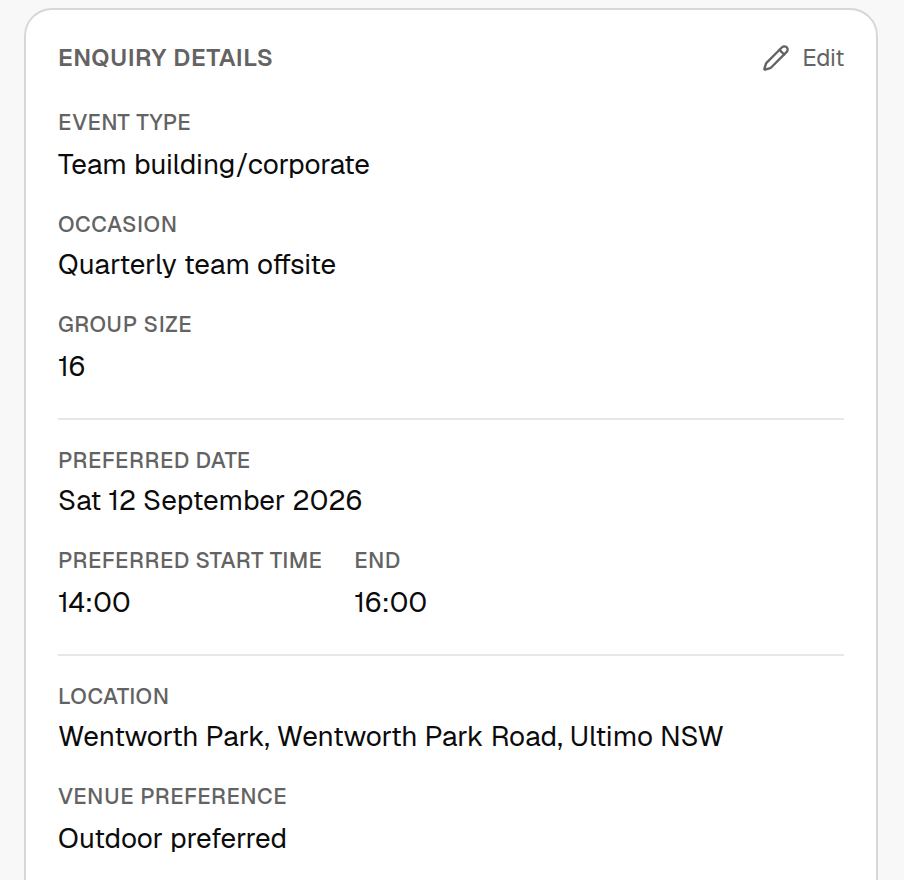
Before you can quote, you need the same handful of details every time: the date, the start and finish time, the number of guests, the full address, whether it is indoors or outdoors, and whether there is a 10 amp outlet and somewhere to park within reach of the set-up spot. If your enquiry form asks for these, your first reply can be a price instead of a list of questions.
Quote reply for an event coffee enquiry
Hi Sarah,

Thanks for getting in touch - yes, we are free on Saturday 13 March.

For 80 guests from 2pm to 4pm at the Lane Cove venue, our two-hour
package is $[price] and includes [number] coffees, a barista, and
setup and pack-down. Alternative milks are included.

We need a standard power point within 10 metres of where the cart
sets up - can you confirm there is one?

I can hold the date until Friday. Reply to this email to confirm
and I will send the booking details and invoice.

[Your name]
The quote request reply guide goes through why each part of that reply is there.
Where do coffee cart bookings come from?
Market and street trade finds you because you are standing there. Event hire has to be won, and it usually starts with an enquiry: a form on your website, an email, a message from a wedding directory listing, or a job posted on a marketplace like Airtasker.
Most of those enquirers contact several carts at once. The first operator to send a clear reply with a price has a real head start, which is the point of the 5-minute rule for leads: you do not need to reply in five minutes, but you do need to reply in the same hour, even if you are mid-service when the enquiry lands.
Repeat corporate work is the steadiest income in event coffee. Keep a record of every client, what you served and what you charged, so the second quote takes a minute.
How will you handle the enquiries?
Once hire work picks up, the hard part stops being the coffee and becomes keeping track of who asked about which date, who you have quoted, and who has not replied. That is what Leadesi is for. Each email or web-form enquiry becomes a lead with the date, hours, headcount and address already pulled out of the message, on a board that shows which enquiries are still waiting on you. You reply from Gmail or Outlook as you do now, and the thread stays linked to the lead.
It is free to start, and the comparison with other CRM and booking tools covers how it differs from the alternatives if you are weighing them up. See pricing for the paid plans.
Common questions
- Do you need a licence for a coffee cart in Australia?
- Usually. Most carts need food business registration or a licence from their council or state food authority, and permission to trade at each place they operate. In Queensland a business selling only drinks such as coffee does not need a food business licence, though food safety laws still apply; in Victoria you register through FoodTrader and lodge a statement of trade before trading.
- How much does it cost to start a coffee cart business?
- The cart and coffee gear are the biggest cost. One Sydney supplier lists a new turnkey cart with machine and grinder for $13,200. Add refrigeration, power, permits, training, insurance, opening stock and transport.
- Do you need a food safety supervisor for a coffee cart?
- Under Standard 3.2.2A, businesses that sell ready-to-eat, potentially hazardous food handled unpackaged need a certified Food Safety Supervisor and trained food handlers. In Queensland a licensed business must have its supervisor available whenever it is operating. Ask your council which category your menu falls into.
- Does a coffee cart business need to register for GST?
- You must register within 21 days of becoming aware that your GST turnover will reach $75,000 a year, so register when you expect to reach it, not after you have.
About the author
Nick Gage. Founder, Leadesi. Runs Battle Archery, a mobile team-building business in Sydney. Read the Leadesi story.
Turn event enquiries into booked coffee carts
Leadesi turns each email or web-form enquiry into a lead with the date, hours, headcount and address already pulled out, so every quote goes out fast. Free to start.