
How to start a catering business in Australia
By Nick Gage · 8 min read
Catering is one of the most common ways to turn a kitchen skill into a business, and plenty of Australians start from their own kitchen. It is also one of the more regulated businesses to start, because you are preparing food other people will eat at an event you are not at the stove for.
This guide covers what you need to register, how food business approval works in NSW, Victoria and Queensland, the national food safety rules that apply to caterers, what to think about when budgeting and pricing, and how to handle the quote requests once they start arriving. Where we could not find a reliable figure, we say so instead of guessing.
Can you start a catering business from home in Australia?
Often yes, but a home kitchen is not exempt from food law. Victorian councils say home-based food businesses must follow the same guidelines and legislation as other food premises, and Queensland's food business licence applies to businesses run from home, commercial premises, a vehicle or a stall.
What changes from state to state, and council to council, is the process: whether you register, notify or apply for a licence, who inspects the kitchen, and whether your property can be used for a home business at all. Talk to your local council's environmental health and planning teams before you buy equipment or take a deposit.
What do you need to start a catering business?
Before your first paid job, you need the business set up, the food side approved, and cover in place. In order:
- An ABN, which you will need for invoicing and tax whatever business structure you choose.
- A business structure: sole trader, partnership or company. A sole trader or partner is personally liable for business debts and claims; a company is a separate legal entity with more set-up and ongoing obligations.
- GST registration once your GST turnover reaches $75,000.
- Food business registration, notification or a licence, through your council or state authority (next section).
- A certified Food Safety Supervisor and trained food handlers, and records of your food safety controls (see the section on food safety).
- Insurance. A law firm's checklist suggests talking to a broker about product liability and public liability cover as a baseline, and considering equipment, business interruption and delivery vehicle cover.
- A way to keep food at safe temperatures when you transport it: fridge, freezer and hot-holding.
The GST rule is set by the ATO and summarised on business.gov.au: you must register within 21 days of becoming aware that your GST turnover will go over $75,000.
The business-structure, insurance and transport points are from Sprintlaw's home catering checklist. Treat it as a starting point and check your own situation with an adviser.
Do you need a licence to start a catering business?
Yes, in the sense that a catering business has to be approved or on record with the regulator before it trades. The form of that approval depends on your state:
NSW. You must notify either your local council or the NSW Food Authority before you start trading. Caterers that sell directly to the final consumer notify their council. Home-based food businesses that do not sell directly to consumers notify the Food Authority instead. The page does not list a notification fee, but your council may have other approvals and charges.
Victoria. Businesses in classes 1, 2, 3 and 3A must be registered with the council; class 4 businesses notify. Councils note that class 1 businesses need a food safety program audited by an approved auditor, and that registrations are renewed each year. Which class a caterer falls into depends on the food you make, so ask your council to confirm yours. If you also serve at markets or events, temporary and mobile premises are registered through the state's FoodTrader system.
Queensland. Most food businesses need a food business licence from their local council, under the Food Act 2006. It is needed if you make food by combining ingredients or sell unpackaged food by retail, and the licence applies whether you work from home, commercial premises, a vehicle or a stall. It lasts up to three years, requires a Food Safety Supervisor who is available when the business is operating, and may also require an accredited food safety program. Assessment looks at your premises design and fit-out, so speak to your council before applying.
Elsewhere. Start with your council's environmental health team, and use the Australian Business Licence and Information Service to list what applies to your location and activity.
What food safety rules apply to a caterer?
Nationally, food safety for caterers is covered by Standard 3.2.2A of the Food Standards Code. It puts caterers and other food service businesses that prepare unpackaged, potentially hazardous food into ready-to-eat food in category one, the higher-risk group, which must put all three food safety management tools in place:
- A Food Safety Supervisor with recognised, formal certification obtained in the past five years.
- Food handlers who have completed training, or have equivalent skills and knowledge, in safe food handling, contamination, cleaning and sanitising, and personal hygiene.
- Records, or another way of showing, that you control the critical points: receiving, storing, processing, displaying and transporting potentially hazardous food, and cleaning and sanitising.
For a caterer, the transport and display points are not an afterthought: food leaves your kitchen and sits at an event, so how you keep it hot or cold on the way and on the day is part of what you will be asked to show.
How much does it cost to start a catering business?
We could not find a reliable published figure for the cost of starting a catering business in Australia,. It depends too heavily on whether you cater from a home kitchen that already meets your council's requirements, or have to fit one out.
What you can do is list the cost lines and get a real quote for each:
- Council registration, notification or licence fees, which are set by each council or state and reviewed every year.
- Food Safety Supervisor certification and food handler training.
- Any changes your council requires to the kitchen.
- Commercial equipment: ovens, refrigeration, hot-holding and insulated transport.
- Insurance premiums, from a broker.
- Serving equipment, packaging and labelling for what you deliver.
- A vehicle, or a delivery arrangement, that keeps food at a safe temperature.
- Ingredients for your first few jobs, bought before the first deposit lands.
How do you price catering?
Catering is usually quoted per person, plus anything that is not food. Published wedding-catering ranges give a sense of the spread: Bridebook puts an evening buffet at $50 to $80 per guest and a formal wedding breakfast at $70 to $100, within an overall affordable tier of $50 to $100 per guest. Those are wedding prices from one publisher, and a corporate lunch or a birthday will sit differently. Use them to sanity-check, not to set your price.
What matters more is what the per-person price includes. Staffing is the usual surprise: the same article recommends one waiter for every 11 guests at a sit-down meal, and notes that hiring a marquee and portable kitchen can add several thousand dollars. Work out your own food cost, labour, travel, equipment hire and waste for a job, then add your margin.
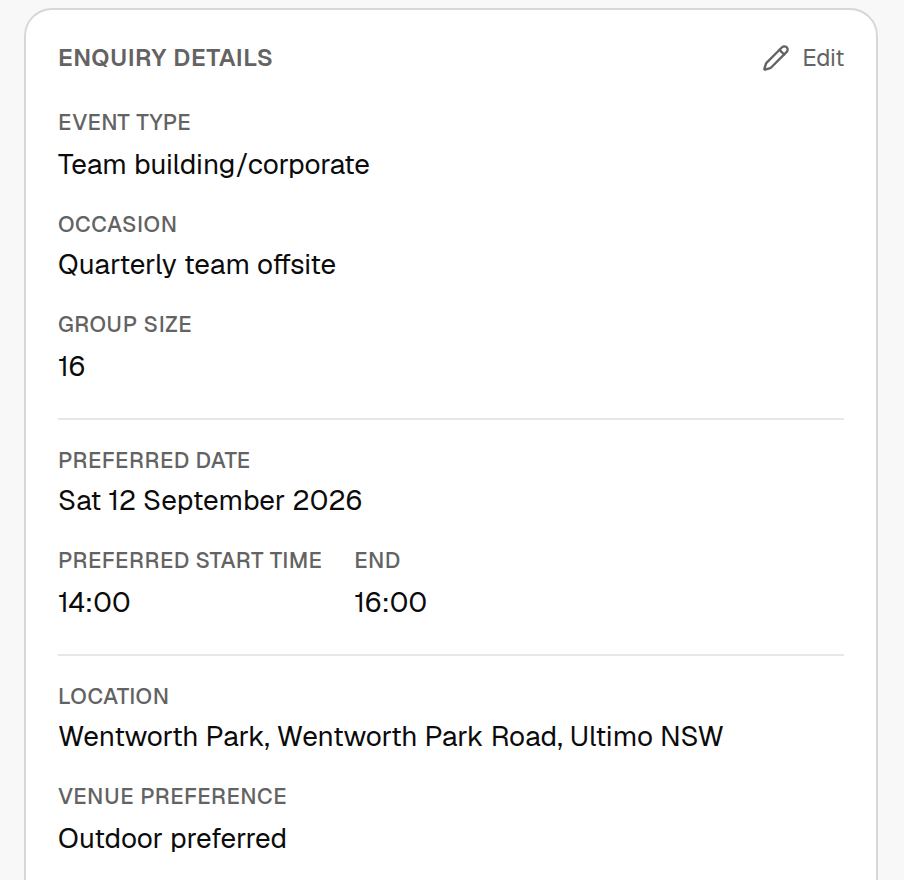
To quote at all you need the same details every time: the date, the start and finish times, the number of guests, any dietary requirements and allergies, the full address, and what kitchen or power is available on site. If your enquiry form asks for them, your first reply can be a price instead of a list of questions.
Quote reply for a catering enquiry
Hi Priya,

Thanks for getting in touch - we have Saturday 13 March free.

For 40 guests at 12.30pm at your Parramatta address, a [menu name]
is $[price] per person, which includes [what is included].
Staff and equipment hire are [included / quoted below].

Could you let me know about any dietary requirements or allergies
in the group, and whether there is a kitchen or fridge space on site?

I can hold the date until Friday. Reply to this email to confirm
and I will send the booking details and invoice.

[Your name]
The quote request reply guide goes through why each part of a reply like that is there.
Where do catering enquiries come from?
Most catering jobs start as an enquiry: an email, a form on your website, or a message through a listing or directory. The person asking is usually organising an event on a date that will not move, and is often asking several caterers at once.
That makes speed and clarity the thing you can control. The 5-minute rule for leads explains why a clear first reply, with a price, tends to beat a slow perfect one. You will not always reply within minutes when you are mid-prep, but replying within the hour puts you ahead of anyone who waits until tomorrow.
Keep a record of every client, what you served and what you charged. Repeat clients are the easiest work to win, and the second quote should take a minute.
How will you handle the enquiries?
Once catering work picks up, the hard part stops being only the food and becomes keeping track of who asked about which date, who you have quoted and who has not replied. That is what Leadesi is for. Each email or web-form enquiry becomes a lead with the date, headcount and address already pulled out of the message, on a board that shows which enquiries are still waiting on you. You reply from Gmail or Outlook as you do now, and the thread stays linked to the lead.
It is free to start, and the comparison with other CRM and booking tools covers how it differs from the alternatives if you are weighing them up. See pricing for the paid plans.
Common questions
- Can you run a catering business from home in Australia?
- Often, yes, if your council approves it. A home kitchen is treated like any other food premises, so you still need the right registration, notification or licence for your state, plus food safety training and records.
- Do you need a licence to start a catering business?
- You need approval from the regulator before you trade. In NSW you notify your council or the NSW Food Authority, in Victoria you register with your council (or notify, for class 4), and in Queensland you apply to your local council for a food business licence.
- What qualifications do you need to start a catering business?
- There is no single qualification, but under Standard 3.2.2A a caterer preparing ready-to-eat, potentially hazardous food needs a Food Safety Supervisor certified within the past five years, trained food handlers, and records of its critical food safety controls.
- Does a catering business need to register for GST?
- You must register within 21 days of becoming aware that your GST turnover will reach $75,000, so register when you expect to reach it, not after you have.
About the author
Nick Gage. Founder, Leadesi. Runs Battle Archery, a mobile team-building business in Sydney. Read the Leadesi story.
Turn catering enquiries into booked jobs
Leadesi turns each email or web-form enquiry into a lead with the date, headcount and address already pulled out, so every quote goes out fast. Free to start.